STRUKTUR PARADIGMATIK ILMU-ILMU KEISLAMAN KLASIK: Dampaknya terhadap Pola Pikir, Sikap, dan Perilaku Keberagamaan
DOI:
https://doi.org/10.30821/miqot.v37i2.83Abstract
Abstrak: Artikel ini mengkaji struktur paradigma Ilmu-ilmu keislaman klasik yang mendominasi diskursus intelektualisme Islam di dunia Islam Sunni. Secara epistemo- logis, dalam upaya meletakkan dasar-dasar keilmuannya, otoritas teks-teks kewahyuan dan pola pikir ulama salaf bercorak analogis (qiyâs), konsensus (ijmâ‘), dan intuitif (dzauqî) sangat mendominasi model pendekatan daripada penalaran akal secara filosofis. Secara ontologis, Ilmu Kalam, Fikih/Usul Fikih dan Ilmu Tasawuf lebih berorientasi pada transformasi nilai-nilai keislaman secara moral spiritual daripada upaya pemenuhan kebutuhan hidup dan peningkatan kesejahteraan hidup secara duniawi. Dalam pada itu, secara umum, pola pikir keilmuan Islam kasik itu berpengaruh terhadap pembentukan corak pemahaman, sikap dan perilaku umat beragama menjadi bersifat eksklusif, kaku, fanatik, tidak kreatif, dan anarkis.Abstract: Paradigmatic Structure of Classical Islamic Sciences, its Impact on Mindset, Attitude and Religious Experience. The aims of this article is to study the paradigmatic structure of the classical Islamic knowledge which had dominated the discources of Islamic intellectualism in the world of Sunni Muslim. Epistemologically, in order to contruct the principles of classical Islamic knowledge, the revealed textsand the thought patterns of ulama Salaf such as analogy (qiyâs), consensus (ijmâ’), and intuitive (dzauqî) had dominated. Axiologically, the purpose of classical Islamic knowlegde is more oriented to transform Islamic values and defense of “religious” in order to gain the here after happiness, howeverthe aspects of socially realistic “secular” life tends to be periferal.In general, both textual-bayânî and ‘irfâni paradigm which till now have been established in the world of Islamic education had affected the mindset, attitude, and conduct of Ummah’s religiosity in order to respon the problems, opportunities, and challenges of modernity and globalization.Kata Kunci: sejarah Islam, tekstual-bayânî, irfânî, intelektualisme Islam klasik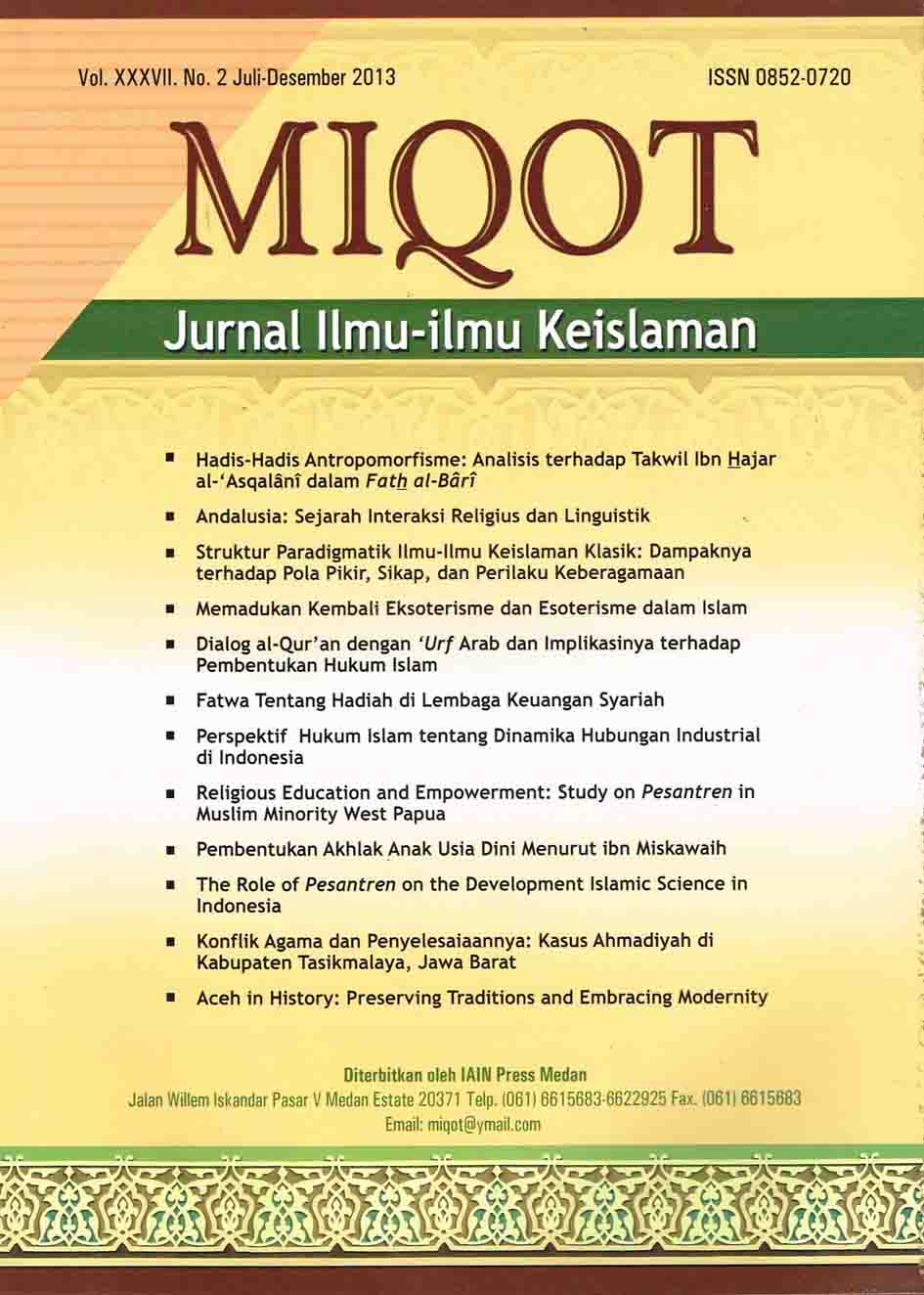
Downloads
Published
2016-04-14
Issue
Section
Articles
License
Authors who publish with this journal agree to the following terms:
- Authors are able to enter into separate, additional contractual arrangements for the non-exclusive distribution of the journal's published version of the work (e.g., post it to an institutional repository or publish it in a book), with an acknowledgement of its initial publication in this journal.
- Authors are permitted and encouraged to post their work online (e.g., in institutional repositories or on their website) prior to and during the submission process, as it can lead to productive exchanges, as well as earlier and greater citation of published work (See The Effect of Open Access).
MIQOT journal provides immediate open access to its content on the principle that making research freely available to the public supports a greater global exchange of knowledge. MIQOT journal Open Access articles are distributed under this CC BY SA.