SYAIKH MOHAMED IDRIS AL-MARBAWI: Kontribusinya dalam Fiqh al-Hadîs
DOI:
https://doi.org/10.30821/miqot.v34i1.187Abstract
Abstrak: Sheikh Mohamed Idris al-Marbawi: His Contribution in Fiqh al-Hadîth. Syaikh Mohamed Idris bin Abdul Raof al-Marbawi’s Bahr al-Madhi is a very popular work within the Malaysian community. This work comprizes a translation of 2781 prophetic traditions adapted from Imâm al-Tirmidhî’s al-Jâmi‘, and still continuously reprented and used by large audience in mosques. This study focuses on studying the method of exegesis (syarh) of fiqh al-hadîs found in Bahr al-Madhi. As such, the writer analyzes document and makes interviews related to issues relevant to the study. The test for methods used by al-Marbawy in Fiqh al-hadîs is conducted by analyzing the findings through varius interpretaion of al-Hadis. In addition, comparative approach is also used by referring to the works of expert in hadith and identifying how far al-Marbawi’s method is similar or diferent to the former views. This study reveals that al-Marbawi’s commentary on Fiqh al- Hadîs is mainly dominated by issues pertaining to ‘aqîdah (Islamic creed), tafsîr (Qur’anic exegesis), hadîs (Islamic traditions), usûl al-fiqh (Islamic jurisprudence), and history and language. Finally, the writer asserts that due to its divergence scope of discussion, authentivcity andreliability, the Bahr al-Madhi remains the main reference in hadith studies applicable for different disciplines of knowledge. Kata Kunci: Mohamed Idris al-Marbawi, Fiqh al-hadis, Bahr al-Madhi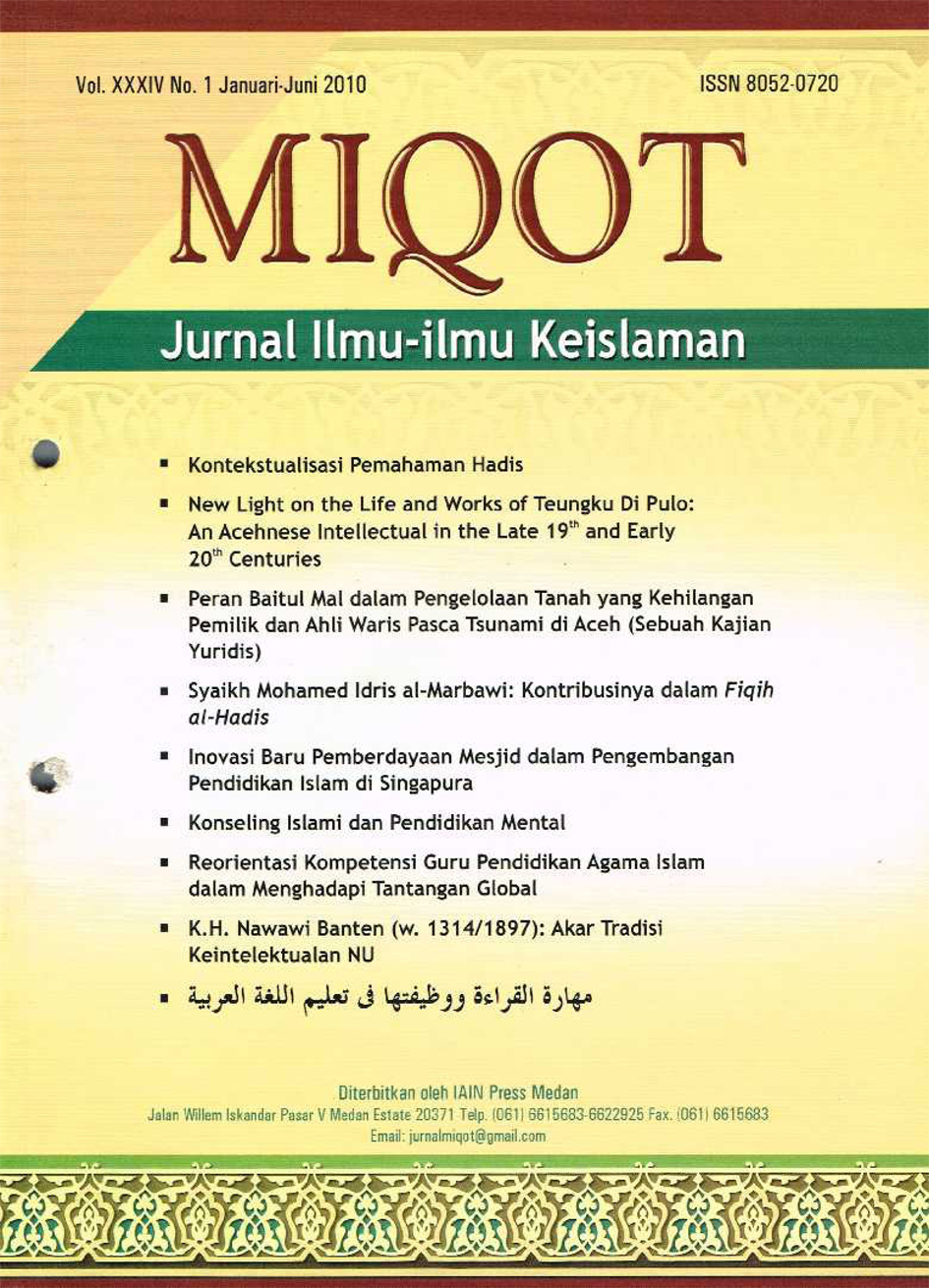
Downloads
Published
2010-06-02
Issue
Section
Articles
License
Authors who publish with this journal agree to the following terms:
- Authors are able to enter into separate, additional contractual arrangements for the non-exclusive distribution of the journal's published version of the work (e.g., post it to an institutional repository or publish it in a book), with an acknowledgement of its initial publication in this journal.
- Authors are permitted and encouraged to post their work online (e.g., in institutional repositories or on their website) prior to and during the submission process, as it can lead to productive exchanges, as well as earlier and greater citation of published work (See The Effect of Open Access).
MIQOT journal provides immediate open access to its content on the principle that making research freely available to the public supports a greater global exchange of knowledge. MIQOT journal Open Access articles are distributed under this CC BY SA.