REFORMULASI ISTINBTH HUKUM ISLAM DARI AL-SUNNAH DALAM PERSPEKTIF YÛSUF AL-QARDHWÎ
DOI:
https://doi.org/10.30821/miqot.v39i2.18Abstract
Abstrak:Tulisan ini difokuskan pada pemikiran Yûsuf al-Qardhâwî tentang al-Sunnah dalamistinbâth hukum Islam. Teori asasi pemikiran Yusuf al-Qardhâwî berkenaan dengan metode komprehensif (manhaj syumûlî), metodebalance (manhaj mutawâzin) dan metode yang memudahkan (manhaj muyassir) menjadi pisau analisis kajian ini. Pada gilirannya, pengkajian atas peran dan fungsi yang melekat pada Rasulullah SAW. adalah urgen guna menguak subtansi al-Sunnah. Menurutnya, terkadang Rasulullah SAW. bersabda dalamkapasitasnya sebagai hakim, sekali waktu muncul dari perannya sebagai kepala negara. Beliau juga terkadang berfatwa dalam posisinya sebagai Rasul, atau sebagai manusia biasa. Sebab itu, memperhatikan konteks di mana dan kapan sabda itu dinyatakan adalah sebuah keniscayaan. Penulis menemukan bahwa Yûsuf al-Qardhâwî menformulasikan delapan prinsip pola istinbâth hukum Islam dari al-Sunnah agar relevan dengan perkembangan tempat dan waktu, dengan tetap berpijak pada spirit al-tasyrî‘dan maqâshid al-syarî‘ah.Abstract:Reformulation of Distillation of Islamic Law in the Perspective of Yûsuf al-Qardhâwî.This article is focused on the thought of Yûsuf al-Qardhâwî about al-sunnah in theistinbâth of Islamic law. The principle theory of Yûsuf al-Qardhâwî’s thought consist of comprehensive method, balance method and simplifying method becomes the theoretical analysis for this study. In turn, the study on the role of Prophet Muhammad is urgently considered to reveal the substance of al-Sunnah. For al-Qardhâwî, at one time, the Prophet could act in the capacity as a judge but in another time as a leader, and as a messenger of Allah which is applicable for universal use. What’s more, his own utterance may also represent his personal expression as a lay person. Hence, looking at the context where and when the decree is stated becomes a necessity. The writer finds that Yûsuf al-Qardhâwî formulates 8 principles ofistinbâth pattern of Islamic law from al-Sunnah to make it relevant to the development of the space and time, by holding tight to the spirit ofal-tasyrî‘ andmaqâshid al-syarî‘ah.Kata Kunci: al-Sunnah, reformulasi, spirital-tasyrî‘,maqâshid al-syarî‘ah, hukum Islam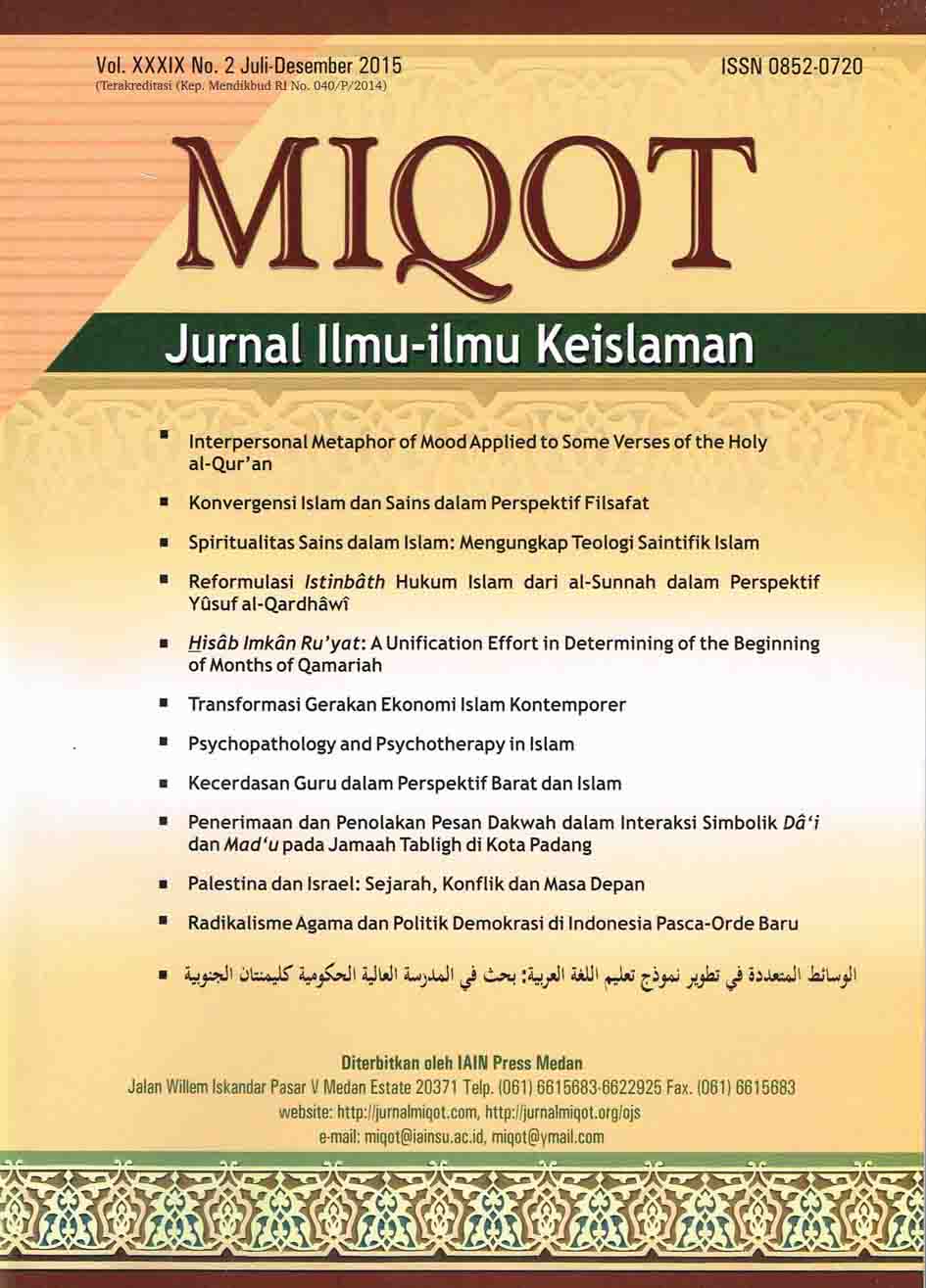
Downloads
Published
2015-12-05
Issue
Section
Articles
License
Authors who publish with this journal agree to the following terms:
- Authors are able to enter into separate, additional contractual arrangements for the non-exclusive distribution of the journal's published version of the work (e.g., post it to an institutional repository or publish it in a book), with an acknowledgement of its initial publication in this journal.
- Authors are permitted and encouraged to post their work online (e.g., in institutional repositories or on their website) prior to and during the submission process, as it can lead to productive exchanges, as well as earlier and greater citation of published work (See The Effect of Open Access).
MIQOT journal provides immediate open access to its content on the principle that making research freely available to the public supports a greater global exchange of knowledge. MIQOT journal Open Access articles are distributed under this CC BY SA.