INTERPERSONAL METAPHOR OF MOOD APPLIED TO SOME VERSES OF THE HOLY AL-QUR’AN
DOI:
https://doi.org/10.30821/miqot.v39i2.16Abstrak
Abstrak: Penerapan Modalitas Metafora Interpersona pada Ayat-Ayat Suci al-Qur’an. Artikel ini merupakan hasil penelitian deskriptif kualitatif yang menguji teori moda metafora interpersonal yang digagas oleh Halliday (1994) apakah relevan diaplikasikan pada ayat-ayat suci al-Qur’an. Metafora interpersona yang dipergunakan dalam survey ini meliputi tiga jenis moda yaitu moda indikatif, moda interogatif dan moda imperatif. Akan tetapi penelitian ini tidak mencakup metafora interpersonal modalitas. Hasil penelitian ini menunjukkan bahwa banyak ayat suci al-Qur’an yang menggunakan transfer moda dalam mengemukakan pesan: sebahagian moda indikatif diekspresikan dalam bentuk interogatif dan imperatif, sebahagian moda imperatif diekspresikan dalam bentuk indikatif dan interogatif, dan beberapa moda interogatif diekspresikan dalam moda indikatif dan imperatif. Hal ini berarti bahwa teori metafora interpersona yang dipelopori Halliday dapat disahkan sebagai teori linguistik yang memenuhi standar.Abstract:This article is the result of a descriptive qualitative research which examine to what extent the theory of Interpersonal Metaphor of mood postulated by Halliday (1994) is relevant to be applied to the verses of the Holy al-Qur’an. The Interpersonal Metaphor applied in this survey covers the three kinds of mood which constitute indicative mood, interrogative mood and imperative mood. This work, however, does not cover the Interpersonal Metaphor of modality. The result shows that some verses of the Holy al-Qur’an use the transference of mood in conveying messages: some indicative moods are expressed in the interrogative and imperative, some imperative moods in the indicative and interrogative, and some interrogative moods in the indicative and imperative. The writer maintains that Halliday’s theory of Interpersonal Metaphor can be justified as an adequate linguistic theory.Keywords: systemic functional linguistics, interpersonal metaphor, al-Qur’an, literature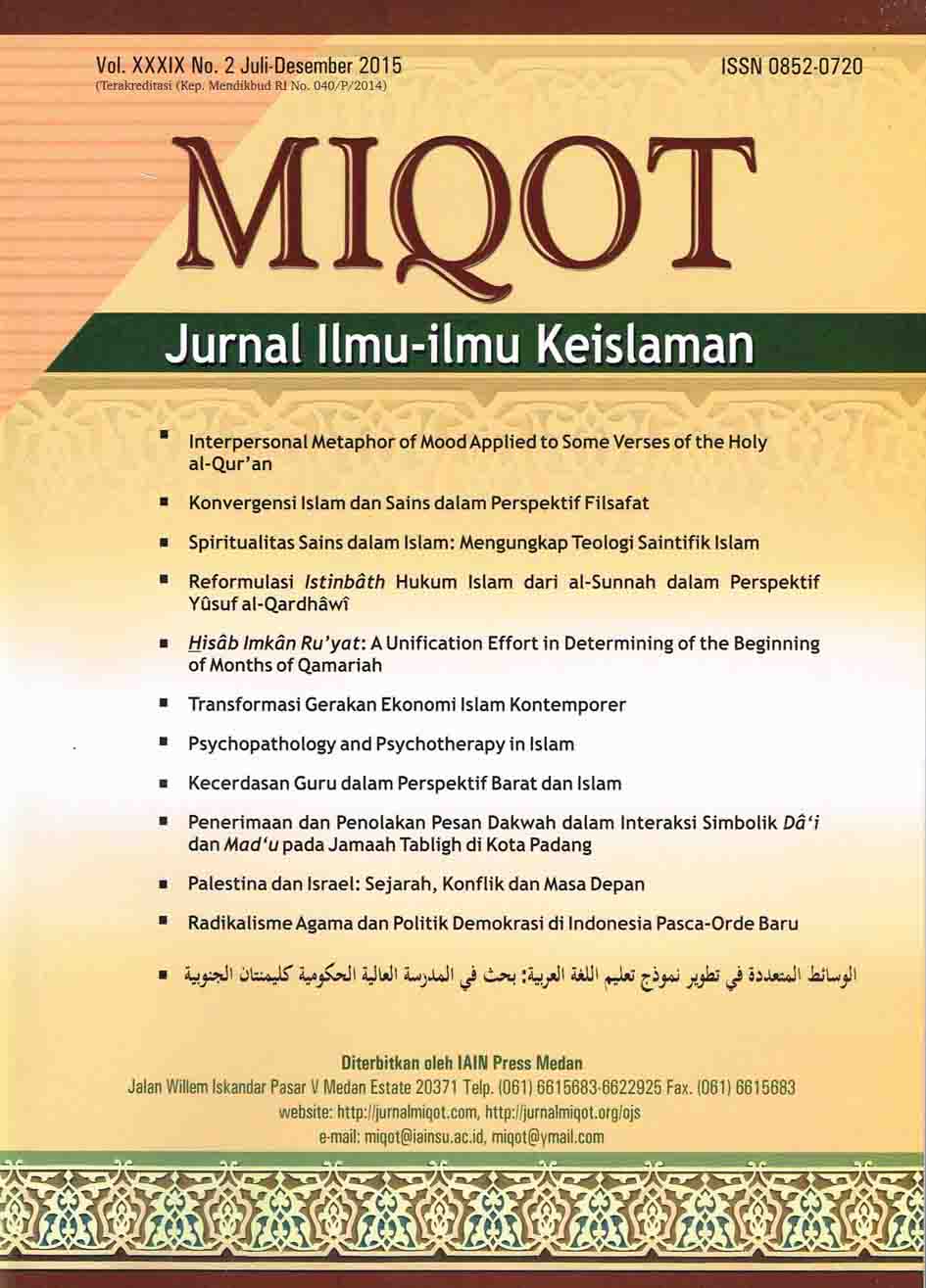
Unduhan
Diterbitkan
2015-12-05
Terbitan
Bagian
Articles
Lisensi
Authors who publish with this journal agree to the following terms:
- Authors are able to enter into separate, additional contractual arrangements for the non-exclusive distribution of the journal's published version of the work (e.g., post it to an institutional repository or publish it in a book), with an acknowledgement of its initial publication in this journal.
- Authors are permitted and encouraged to post their work online (e.g., in institutional repositories or on their website) prior to and during the submission process, as it can lead to productive exchanges, as well as earlier and greater citation of published work (See The Effect of Open Access).
MIQOT journal provides immediate open access to its content on the principle that making research freely available to the public supports a greater global exchange of knowledge. MIQOT journal Open Access articles are distributed under this CC BY SA.