ANALISIS METODOLOGIS-FILOSOFIS KONSEP TAFSIR JAML AL-BANN
DOI:
https://doi.org/10.30821/miqot.v38i2.57Abstract
Abstrak: Artikel ini mencoba untuk mengulas metode penafsiran Jamâl al-Bannâ secara metodologis dan filosofis. Dimulai dengan upaya untuk mendekonstruksi interpretasi hasil dari semua mufasir klasik, Jamâl al-Bannâ mengusulkan tiga tahap dalam penafsiran al-Qur’an, yaitu pendekatan seni, pendekatan psikologis, dan pendekatan rasional. Ketiganya merupakan tahapan hierarkis untuk bisa sampai pada sebuah penafsiran. Setelah bisa sampai pada tahap penafsiran, Jamâl al-Bannâ tidak merekomendasikan metode tertentu atau membatasi ilmu pengetahuan tertentu sebagai metode analisa penafsiran. Ia menolak jika salah satu metode tertentu memiliki garansi sebagai satu-satunya cara untuk menemukan kebenaran, karena al-Qur’an tidak harus dibatasi. Dalam sosiologi pengetahuan, pemikirannya mirip denganAgainst Method (Anarkisme Metode) Paul K. Feyerabend. Bagi Jamâl al-Bannâ, manusia sangat otonom dan bebas untuk menafsirkan selama itu sejalan dengan prinsip-prinsip humanis dan universal yang terkandung dalam al-Qur’an.Abstract: Methodological and Philosophical Analysis of Jamâl al-Bannâ’s Qur’anic Exegesis. This article seeks to analyze the method of Jamâl al-Bannâ’s interpretation. Beginning with an attempt to deconstruct the interpretation of the results of all classicalmufassir, Jamâl al-Bannâ proposed three stages in the interpretation of the Qur’an that include such approaches as stylistic, psychological, and rational method. All three approaches are utilized hierarchically in order to come to an interpretation. At the rational stage of Qur’anic exegesis, Jamâl al-Bannâ didn’t recommend a specific method or limit the science to a particular method. He refused that one particular method has the warranty as the only interpretation to seek the way for the truth, because the Qur’an should not be restricted. In the sociology of knowledge, his thinking is similar to that of Paul K. Feyerabend’s Against Method. According to Jamâl al-Bannâ, human beings are very autonomous and free to interpret the Qur’an as long as it is in line with the principles of humanistic and universal values as enshrined there in.Kata Kunci: Tafsir al-Qur’an, Jamâl al-Bannâ, pendekatan seni, metode penafsiran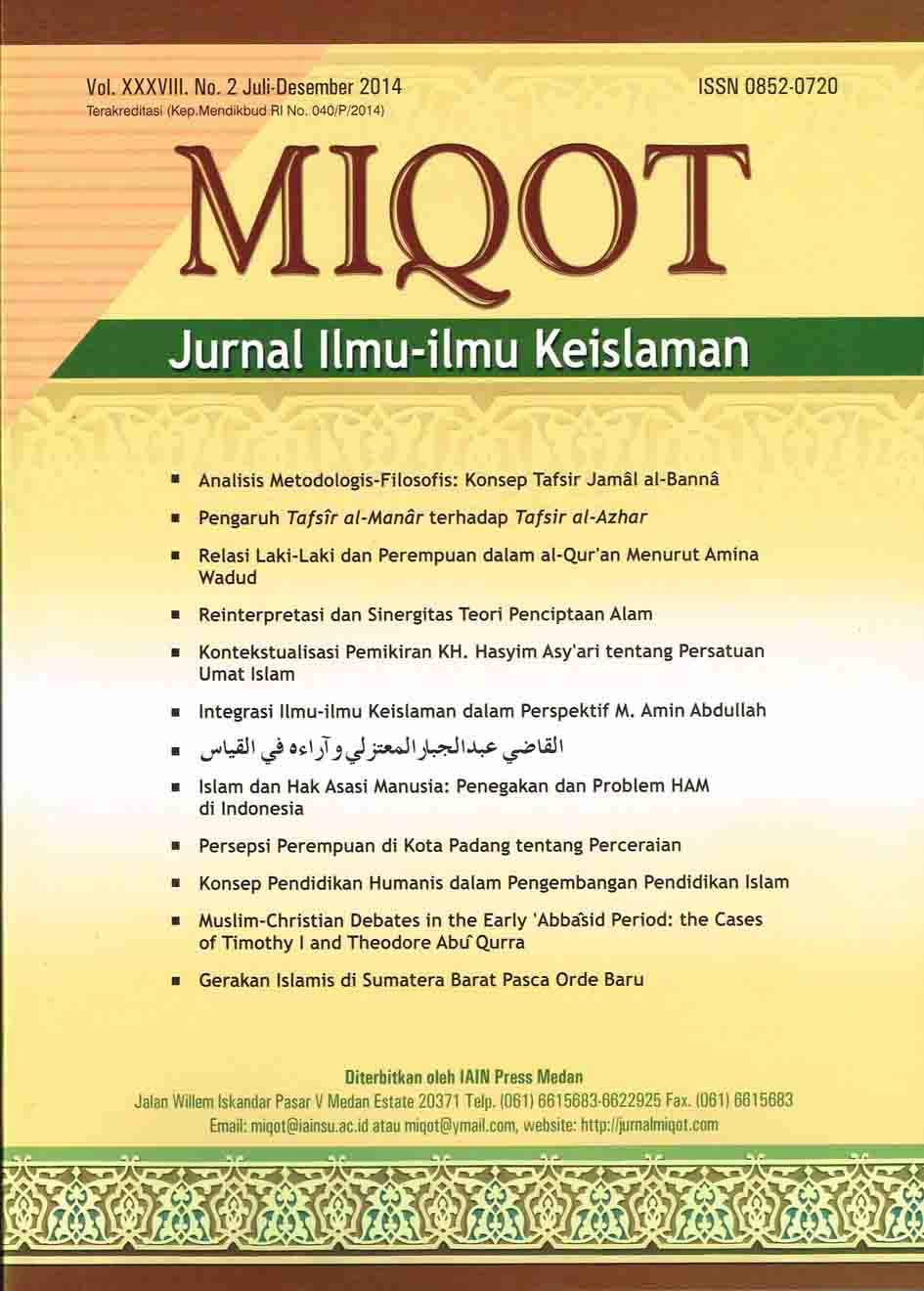
Downloads
Published
2016-02-09
Issue
Section
Articles
License
Authors who publish with this journal agree to the following terms:
- Authors are able to enter into separate, additional contractual arrangements for the non-exclusive distribution of the journal's published version of the work (e.g., post it to an institutional repository or publish it in a book), with an acknowledgement of its initial publication in this journal.
- Authors are permitted and encouraged to post their work online (e.g., in institutional repositories or on their website) prior to and during the submission process, as it can lead to productive exchanges, as well as earlier and greater citation of published work (See The Effect of Open Access).
MIQOT journal provides immediate open access to its content on the principle that making research freely available to the public supports a greater global exchange of knowledge. MIQOT journal Open Access articles are distributed under this CC BY SA.