OTORITAS HIRARKI KUTUB AL-SITTAH DAN KEMANDEGAN KAJIAN FIKIH
DOI:
https://doi.org/10.30821/miqot.v38i1.54Abstract
Abstrak: Tulisan ini mencoba melakukan pemetaan masalah yang membuat kajian fikih stagnan sebagaimana diklaim oleh sebagian ilmuwan hukum Islam. Otoritas hierarki Kutub al-Sittah ternyata merupakan persoalan mendasar yang membatasi ulama berijtihad. Hal ini dikarenakan adanya pembatasan terhadap penggunaan kitab-kitab hadis di level tertinggi. Istilah Kutub al-Sittah semestinya diletakkan sebagai kitab fikih, yang ketika penggunaan awalnya dianggap kitab hadis. Menurut penulis, hal ini membuat Kutub al-Sittah cenderung menolak kritikan, sebab ada dimensi kesakralan di dalamnya. Karenanya perlu dilakukan kontekstualisasi terhadap pemahaman nash hadis yang dianggap untuk mengikuti perubahan sosial. Menurut penulis deduksi terhadap nilai teks nash tidak mengenyampingkan teks nash sebagai pijakan dalam pengembangan konsep maslahat. Otentisitas kajian fikih terkait dengan nilai-nilai normatif nash, namun hal tersebut tidak bisa langsung diterapkan dalam kehidupan.Abstract: The Authority of Kutub al-Sittah Hierarchy and the Stagnant of Fiqh Studies. This paper tries to map predicaments that contributed to fiqh studies that had been claimed to be stagnant at least by a few Islamic legal scholars. The authority of Kutub al-Sittah hierarchy, in fact, has become an important problem that restricted the learned scientific community or ulama to practice ijtihad. This stemmed from the limitation of the hadits books use at the highest level. The so called Kutub al-Sittah should be properly signified as fiqh book. According to the author, this makes Kutub al-Sittah seems to be resistant to criticism, due to the sacred and intrinsic dimension in it. Therefore, it is urgent that understanding the argument of Traditions which are relevant and in line with the social dynamics should be contextualized. He also maintains that legal deduction of the text of the Traditions does not necessarily overrule the principle values of the text as a foundation for the maslahat concept. In addition, the argues that the authority of the study of Islamic jurisprudence is closely related to the normative values of the text, but nonetheless such norms could not be directly applied to the real life.Kata Kunci: otoritas, Kutub al-Sittah, fikih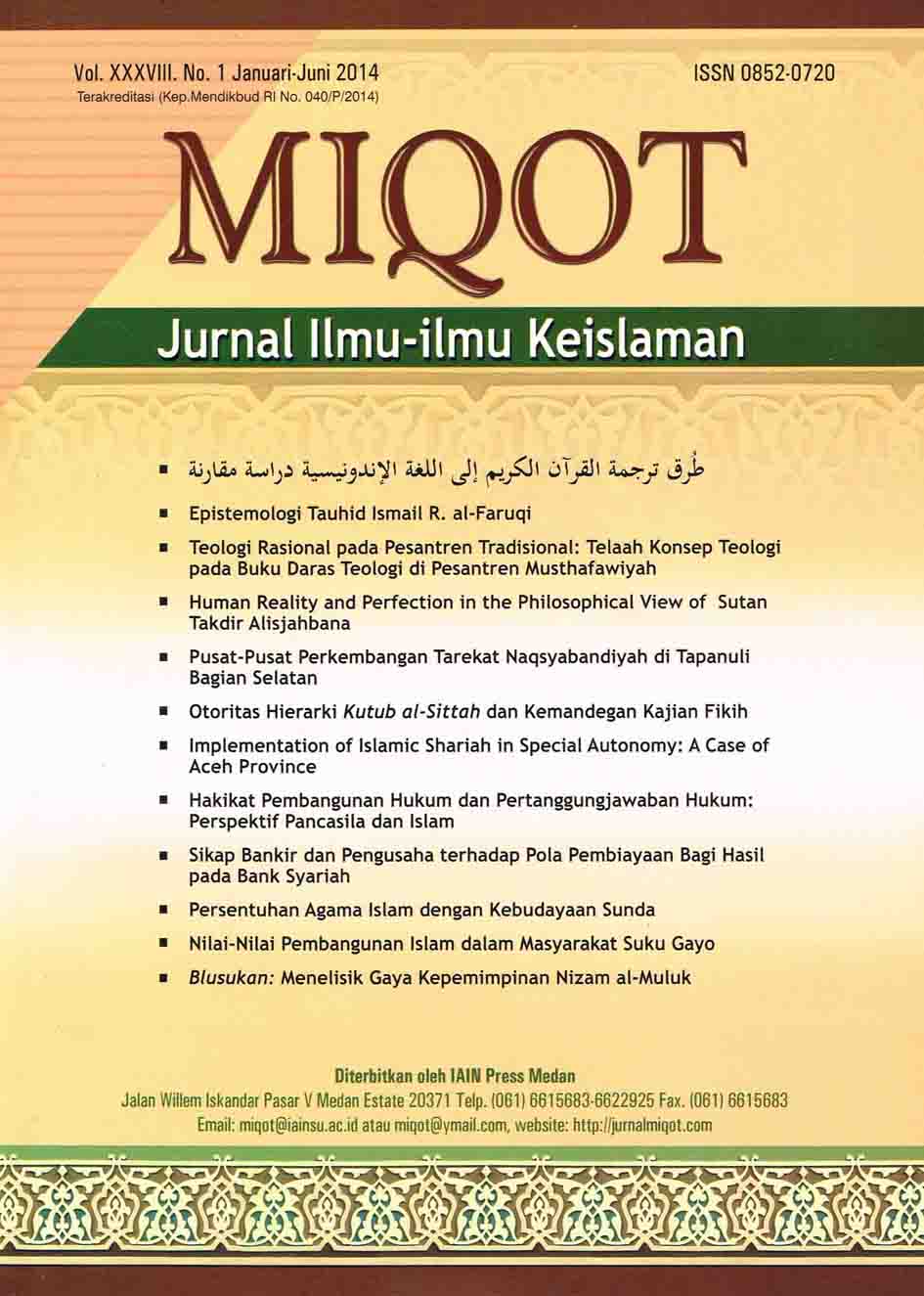
Downloads
Published
2014-06-09
Issue
Section
Articles
License
Authors who publish with this journal agree to the following terms:
- Authors are able to enter into separate, additional contractual arrangements for the non-exclusive distribution of the journal's published version of the work (e.g., post it to an institutional repository or publish it in a book), with an acknowledgement of its initial publication in this journal.
- Authors are permitted and encouraged to post their work online (e.g., in institutional repositories or on their website) prior to and during the submission process, as it can lead to productive exchanges, as well as earlier and greater citation of published work (See The Effect of Open Access).
MIQOT journal provides immediate open access to its content on the principle that making research freely available to the public supports a greater global exchange of knowledge. MIQOT journal Open Access articles are distributed under this CC BY SA.