PEMISKINAN TERHADAP PELAKU TINDAK PIDANA KORUPSI DALAM PERSPEKTIF HUKUM PIDANA POSITIF DAN HUKUM PIDANA ISLAM
DOI:
https://doi.org/10.30821/miqot.v39i1.41Abstract
Abstrak: Penanganan terhadap persoalan korupsi merupakan tugas berat di setiap negara dalam mencapai good governance. Di Indonesia, sejak bergulirnya reformasi, terjadi peningkatan tindak pidana korupsi dan penyebaran pelakunya semakin meluas. Tulisan ini mencoba memberikan solusi tentang sanksi hukum pemiskinan koruptor, baik dari perspektif hukum pidana positif maupun hukum Islam. Menurut penulis, pemiskinan koruptor yang berarti sebuah hukuman untuk membuat tersangka menjadi miskin akibat aset dan harta benda yang dimilikinya sebenarnya mendapat preseden dari putusan-putusan hakim yang menyita harta koruptor. Dalam hukum pidana Islam, pemiskinan koruptor sebenarnya tidak sejalan dengan konsep ‘uqûbah atau penjatuhan sanksi bagi seorang terdakwa. Namun demikian, sebagai sebuah bentuk hukuman takzir berupa denda sejumlah uang yang dituntut oleh Jaksa Penuntut Umum terhadap seorang terpidana kasus korupsi, tampaknya boleh dilakukan.Abstract: Impoverishment of Corruption Crime in the Perspective of Positive Criminal Law and Islamic Law. Dealing with corruption issue is a tough task of any country in achieving good governance. In Indonesia since reformation era began, there was an increase in the number of corruption crime This paper attempts to provide solution pertaining to sanctions to impoverish corruption crime, both in the perspectives of Islamic positive criminal law and Islamic penal law. According to the author, the impoverishment of corruption crime in the sense of sanction that causes the suspect in the state of poverty due to the fact that their property and asset prescribed in the precedent of the decisions of judges who confiscate criminals. In the Islamic perspective, the impoverishment of the corruption crime as punishment is not in line with a form of punishment named ‘uqûbah or impose sanctions for a defendant. Nevertheless, as a form of punishment in the form of fines as ta’zîr, an amount of money demanded by the public prosecutor against a convicted cases of corruption, perceived to be feaseable to be applied.Kata Kunci: korupsi, koruptor, pemiskinan, jinâyah, hukum pidana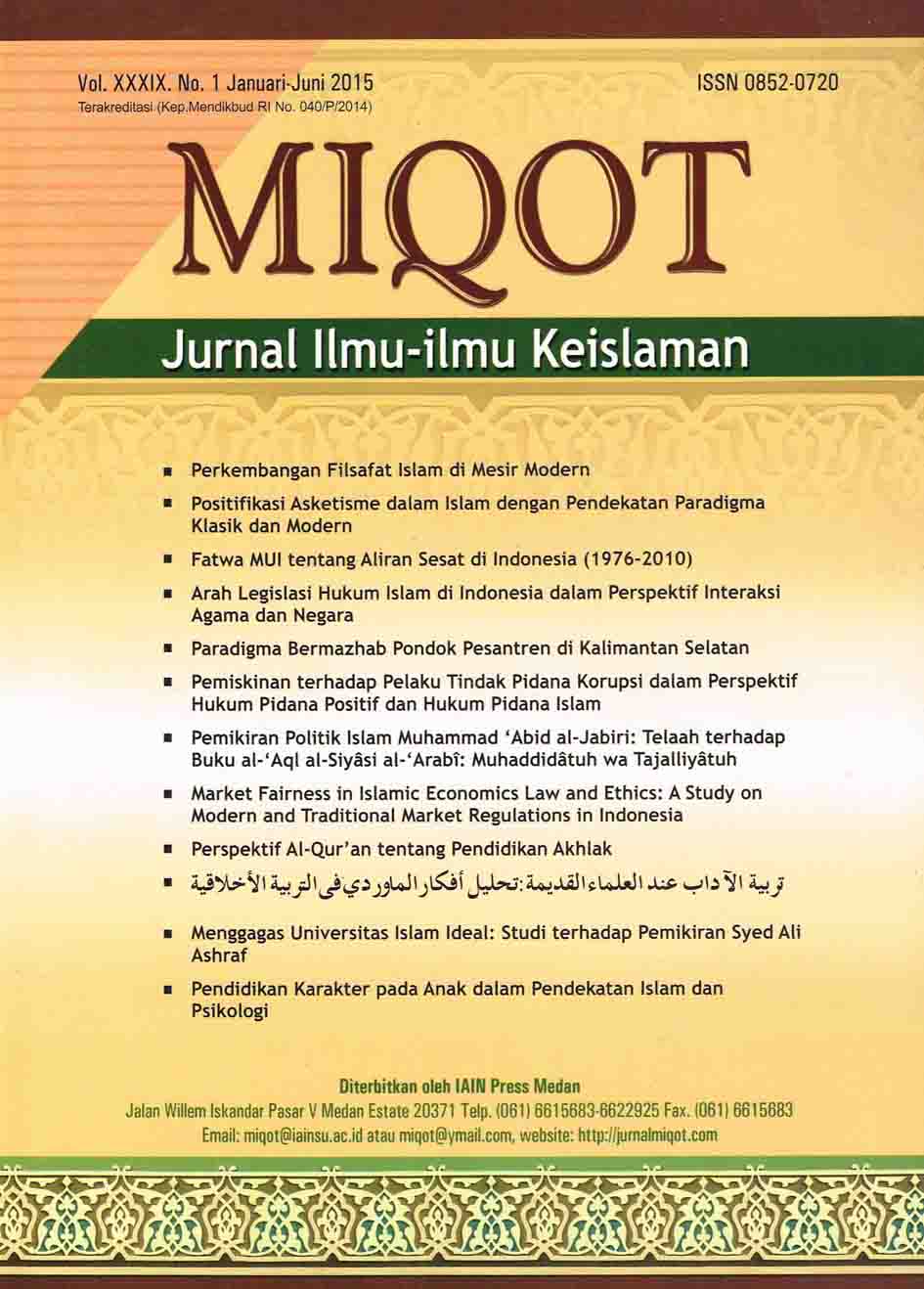
Downloads
Published
2015-06-09
Issue
Section
Articles
License
Authors who publish with this journal agree to the following terms:
- Authors are able to enter into separate, additional contractual arrangements for the non-exclusive distribution of the journal's published version of the work (e.g., post it to an institutional repository or publish it in a book), with an acknowledgement of its initial publication in this journal.
- Authors are permitted and encouraged to post their work online (e.g., in institutional repositories or on their website) prior to and during the submission process, as it can lead to productive exchanges, as well as earlier and greater citation of published work (See The Effect of Open Access).
MIQOT journal provides immediate open access to its content on the principle that making research freely available to the public supports a greater global exchange of knowledge. MIQOT journal Open Access articles are distributed under this CC BY SA.