FATWA MUI TENTANG ALIRAN SESAT DI INDONESIA (1976-2010)
DOI:
https://doi.org/10.30821/miqot.v39i1.38Abstract
Abstrak: Sampai saat ini, tampaknya klaim kebenaran dan penyesatan, bahkan pengkafiran (takfîr), masih terus berlangsung. Di Indonesia, adanya Fatwa ‘Sesat’ Majelas Ulama Indonesia (MUI) mengindikasikan adanya klaim ini. Tulisan ini berupaya melacak pemikiran aliran yang disesatkan MUI. Penulis berargumen bahwa berdasarkan penelitian terhadap Fatwa MUI Bidang Aqidah dan Aliran Keagamaan (1976-2010) dapat diketahui bahwa klaim ini semata-mata merefleksikan peran MUI sebagai pengawal dan penjaga aqidah umat. Selanjutnya, penulis menyatakan bahwa pemikiran aliran-aliran sesat di Indonesia berakar dalam Sejarah Pemikiran Islam dan Fatwa MUI tentang aliran-aliran sesat di Indonesia dan hal ini tidak lebih dari representasi sikap tegas kelompok mayoritas di sepanjang sejarah Islam terhadap kelompok minoritas yang dipandang telah sesat atau kafir keluar dari mainstream. Kendati demikian, kelihatannya aliran sesat akan tetap ada di bumi Indonesia.Abstract: The Ruling of Indonesian Council of Ulama on Heretical Sects in Indonesia (1976-2010). The claims of truth and deception, even condemnation of unbeliever (takfir), still continue to happen to the present time. In Indonesia, the introduction of the Council of Ulama (MUI) ruling or fatwa on misleading sect may proof the widespred claim. This paper attempts to trace the historical dynamics of acclaimed ambiguous sects by the MUI. However, the author argues that based on the study of the MUI fatwa section of Islamic faith and religious school of thoughts (1976-2010) it is revealed that such claim is purely a reflection of the MUI’s role as a safeguard and keeper of the faith of Islamic community. In addition, he further maintains that the thought of the misleading sects in Indonesia is deeply rooted in the history of Islamic thought and MUI fatwa of heretical sects in Indonesia is nothing more than a representation of a firm attitude of the majority throughout Islamic history against minorities of whom have been considered being misguided and go beyond the mainstreams, but nonetheless, it seems that such a sect will remain in the land of Indonesia.Kata Kunci: fatwa, aliran sesat, takfîr, Majelis Ulama Indonesia (MUI), akidah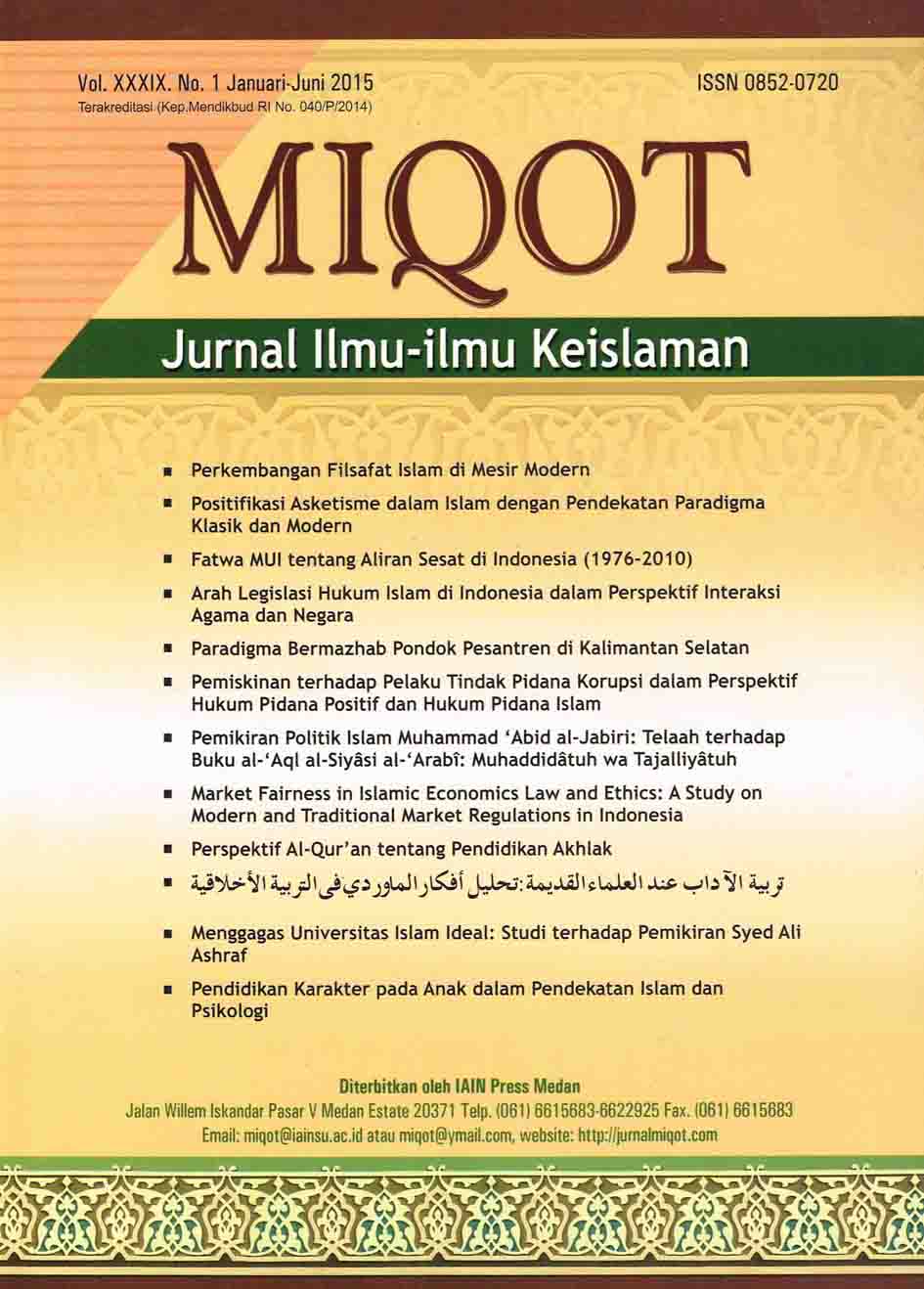
Downloads
Published
2015-06-09
Issue
Section
Articles
License
Authors who publish with this journal agree to the following terms:
- Authors are able to enter into separate, additional contractual arrangements for the non-exclusive distribution of the journal's published version of the work (e.g., post it to an institutional repository or publish it in a book), with an acknowledgement of its initial publication in this journal.
- Authors are permitted and encouraged to post their work online (e.g., in institutional repositories or on their website) prior to and during the submission process, as it can lead to productive exchanges, as well as earlier and greater citation of published work (See The Effect of Open Access).
MIQOT journal provides immediate open access to its content on the principle that making research freely available to the public supports a greater global exchange of knowledge. MIQOT journal Open Access articles are distributed under this CC BY SA.