KALIGRAFI ARAB DIGITAL AYAT AL-QUR'AN DI DUNIA MAYA
DOI:
https://doi.org/10.30821/miqot.v40i1.248Abstract
Abstrak: Kebudayaan Muslim memperkenalkan tradisi kaligrafi sebagai bentuk seni rupa Islam yang menggunakan ayat-ayat al-Qur’an sebagai fokus utama. Artikel ini hendak mengkaji kaligrafi Arab digital ayat al-Qur’an di dunia maya. Artikel menyimpulkan bahwa tradisi kaligrafi ikut berkembang seiring perkembangan ilmu pengetahuan dan teknologi. Para ahli kaligrafi mulai memanfaatkan dan menggunakan media komputer dan internet untuk mengembangkan khazanah kaligrafi. Sejauh ini ditemukan banyak situs internet yang telah mempublikasikan berbagai model kaligrafi digital dengan memakai berbagai ayat al-Qur’an. Ada dua jenis kaligrafi Arab digital, yaitu kaligrafi kontemporer yang bebas mengikuti perkembangan zaman, bersifat abstrak, menyesuaikan kondisi alam, benda dan makhluk hidup; serta qawa‘id yang sudah ada ketentuan dan patokan dalam penulisannya. Ada tujuh jenis yakni tsuluts, naskhi, farisi, diwani, diwani jali, kufi, dan riq‘ah. Kedua jenis kaligrafi telah memberikan kontribusi bagi kajian estetika Islam. Abstract: Digital Arabic Calligraphy of the Qur’anic Verses in Cyberspace. Islamic Civililation introduced calligraphy tradition as a form of Islamic art the main foculs of which mainly the verses of the as al-Qur’an. This article examines the digital Arabic calligraphy of of the Quranic Verses in cyberspace. This article found that calligraphy tradition have evolved along the development of science and technology. Through computer technology progress, calligraphers began to harness and use the computer and internet media to develop treasures of calligraphy. So far it was found that many internet sites that have published various models of digital calligraphy by using various verses of the al-Qur’an. From the data, it is known that there are two types of digital Arabic calligraphy. First is a contemporary calligraphy that looks freely with current development, abstract, the weather condition, objects and mortal. Second is qawa'id that having standards in writing. There are seven types namely tsuluts, naskhi, farisi, diwani, diwani jali, kufi, dan riq‘ah. Both types of calligraphy has contributed to the study of Islamic aesthetics. Kata Kunci: kaligrafi Arab, digital, al-Qur’an, internet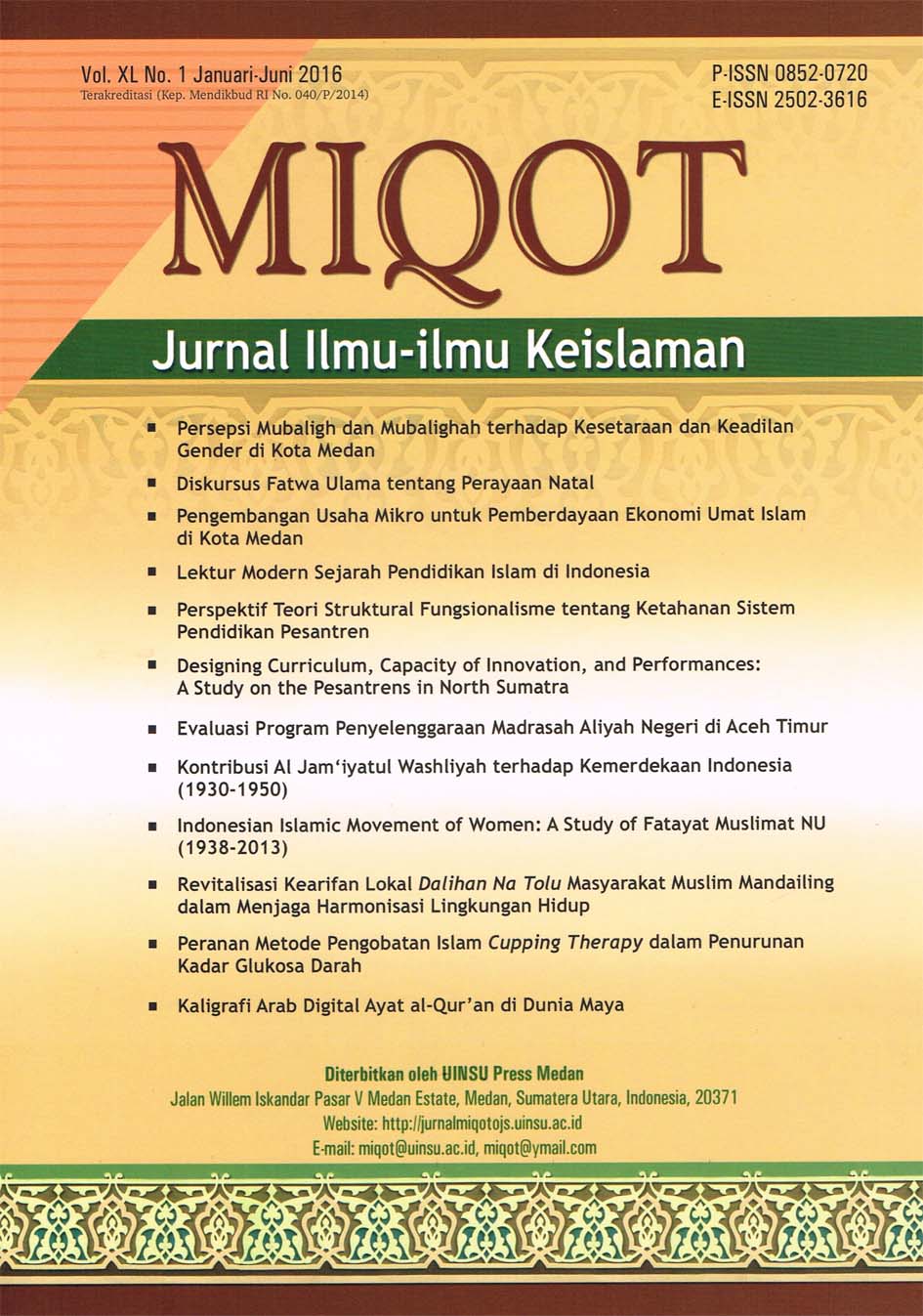
Downloads
Published
2016-06-19
Issue
Section
Articles
License
Authors who publish with this journal agree to the following terms:
- Authors are able to enter into separate, additional contractual arrangements for the non-exclusive distribution of the journal's published version of the work (e.g., post it to an institutional repository or publish it in a book), with an acknowledgement of its initial publication in this journal.
- Authors are permitted and encouraged to post their work online (e.g., in institutional repositories or on their website) prior to and during the submission process, as it can lead to productive exchanges, as well as earlier and greater citation of published work (See The Effect of Open Access).
MIQOT journal provides immediate open access to its content on the principle that making research freely available to the public supports a greater global exchange of knowledge. MIQOT journal Open Access articles are distributed under this CC BY SA.