MURTAD: ANTARA HUKUMAN MATI DAN KEBEBASAN BERAGAMA (Kajian Hadis dengan Pendekatan Tematik)
DOI:
https://doi.org/10.30821/miqot.v32i2.165Abstract
Abstract: Apostasy: Between Death Penalty and Religious Freedom: A Thematic Study of Hadîth. One of the most sensitive discussions in Islamiclaw is the issue of apostasy. Some scholars of Islam maintain that the dead penalty for the apostate found in the precept of Islamic law is perceived as contrary to human rights, since it is against the principles of religious freedom. This paper presents a different perspective, which explains that this allegation is not entirely true. Not merely because of the apostasy. By using thematic hadis approach, this essay attempt to proof that it is apostasy which combined with rivalry against the state and enmity against Islam (bughât) that can be penalized with death sentence. And this can be executed after the state have decided to do so. Kata Kunci: murtad, kebebasan beragama, doktrin, qânûn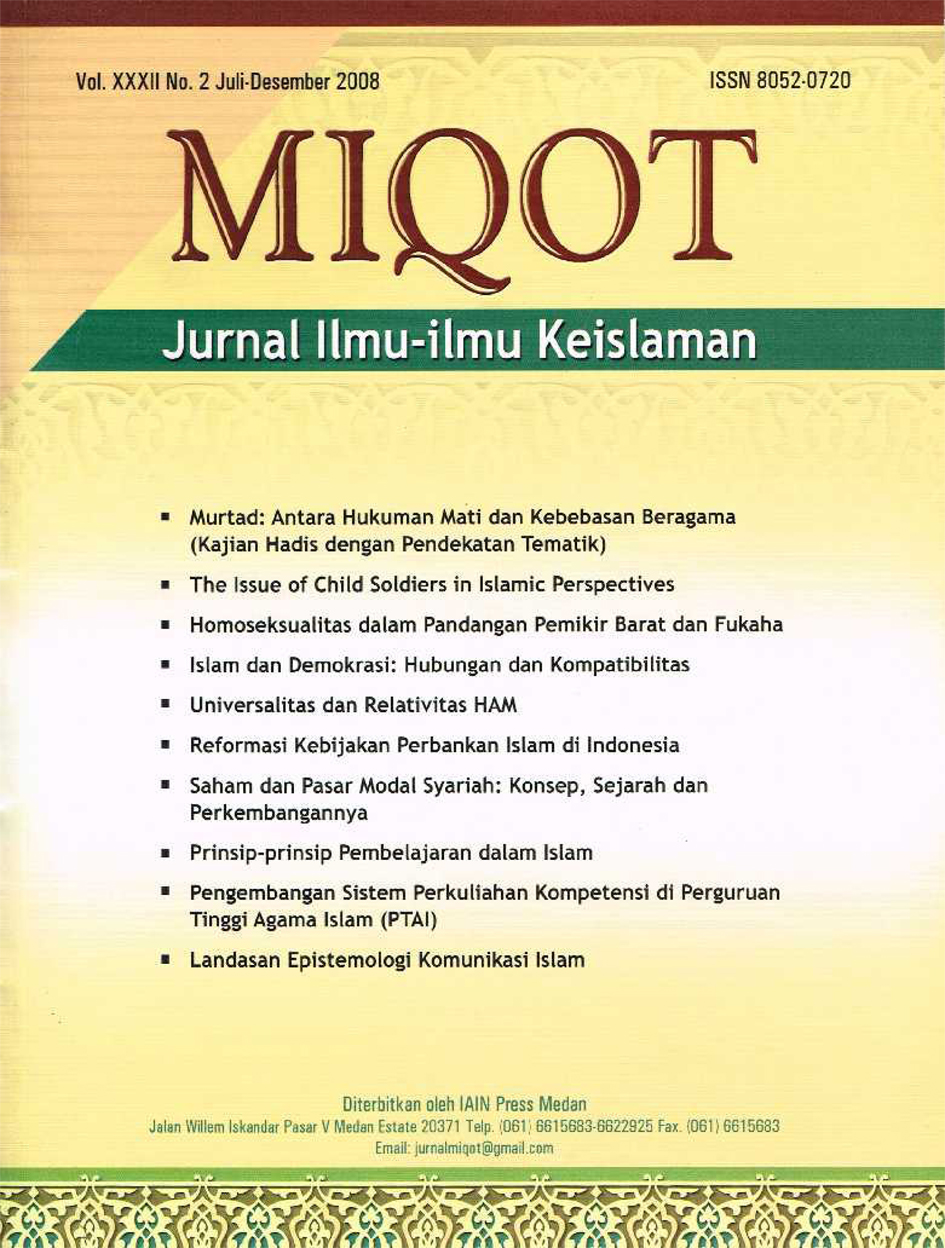
Downloads
Published
2008-12-02
Issue
Section
Articles
License
Authors who publish with this journal agree to the following terms:
- Authors are able to enter into separate, additional contractual arrangements for the non-exclusive distribution of the journal's published version of the work (e.g., post it to an institutional repository or publish it in a book), with an acknowledgement of its initial publication in this journal.
- Authors are permitted and encouraged to post their work online (e.g., in institutional repositories or on their website) prior to and during the submission process, as it can lead to productive exchanges, as well as earlier and greater citation of published work (See The Effect of Open Access).
MIQOT journal provides immediate open access to its content on the principle that making research freely available to the public supports a greater global exchange of knowledge. MIQOT journal Open Access articles are distributed under this CC BY SA.