HUDÛD DAN HAM: ARTIKULASI PENGGOLONGAN HUDÛD ABDULLAHI AHMED AN-NA’IM
DOI:
https://doi.org/10.30821/miqot.v35i2.149Abstract
Abstrak:Hudûd adalah ancaman hukuman yang ditegaskan al-Qur’an dan Sunnah berdasarkan teori hukuman yang menganut aspek reformasi. Penggolonganhudûd ke dalam enam macam merupakan hasil ijtihad fukaha yang bersifat tekstual, dan nash sebagai sumber pengambilanhudûd masih diperdebatkan. Sehingga muncul reaksi pemikir hukum Islam Modern, terutama penerapan hukumanhudûd dalam konteks negara-bangsa berbenturan dengan prinsip penologis dan keuniversalan norma HAM. Tulisan ini mengkaji pemikiran an-Na’im dalam upaya menemukan kesesuaian antara syarî‘ah dan HAM. Hasil penelitian menunjukkan titik temunya adalah membatasi penerapan hudûd ke dalam empat jenis, sesuai dengan prinsip ayat Makkiyah yang mengandung nilai mashlahah terealisir dalam teori naskh.Abstract: Punishment and Human Rights: The Articulation of Abdullahi Ahmed an-Na’im’s Categorization of Hudûd. Hudûd is an offence for which punishment prescribed by the Qur’an and Sunnah based on the theory of punishment constituting reformation aspect. The classification of hudûd into six categories is the product of literal legal deduction of Islamic jurisprudents, and that the legal argument forhudûd is still debatable which lead to reactions of modern Islamic legal thinkers, especially on the application of hudûd in the context of those countries which are against penological principles and the universality of human right norms. This article studies the thoughts of an-Na’im in an attempt to seek confirmity between syarî‘ah. This research reveals that the meeting point between the two would be the restriction of the application of hudûd into four types, in line with the prinples of Meccan verses bearing public interest values realized in the theory of abrogation.Kata Kunci: hudûd, HAM, mashlahah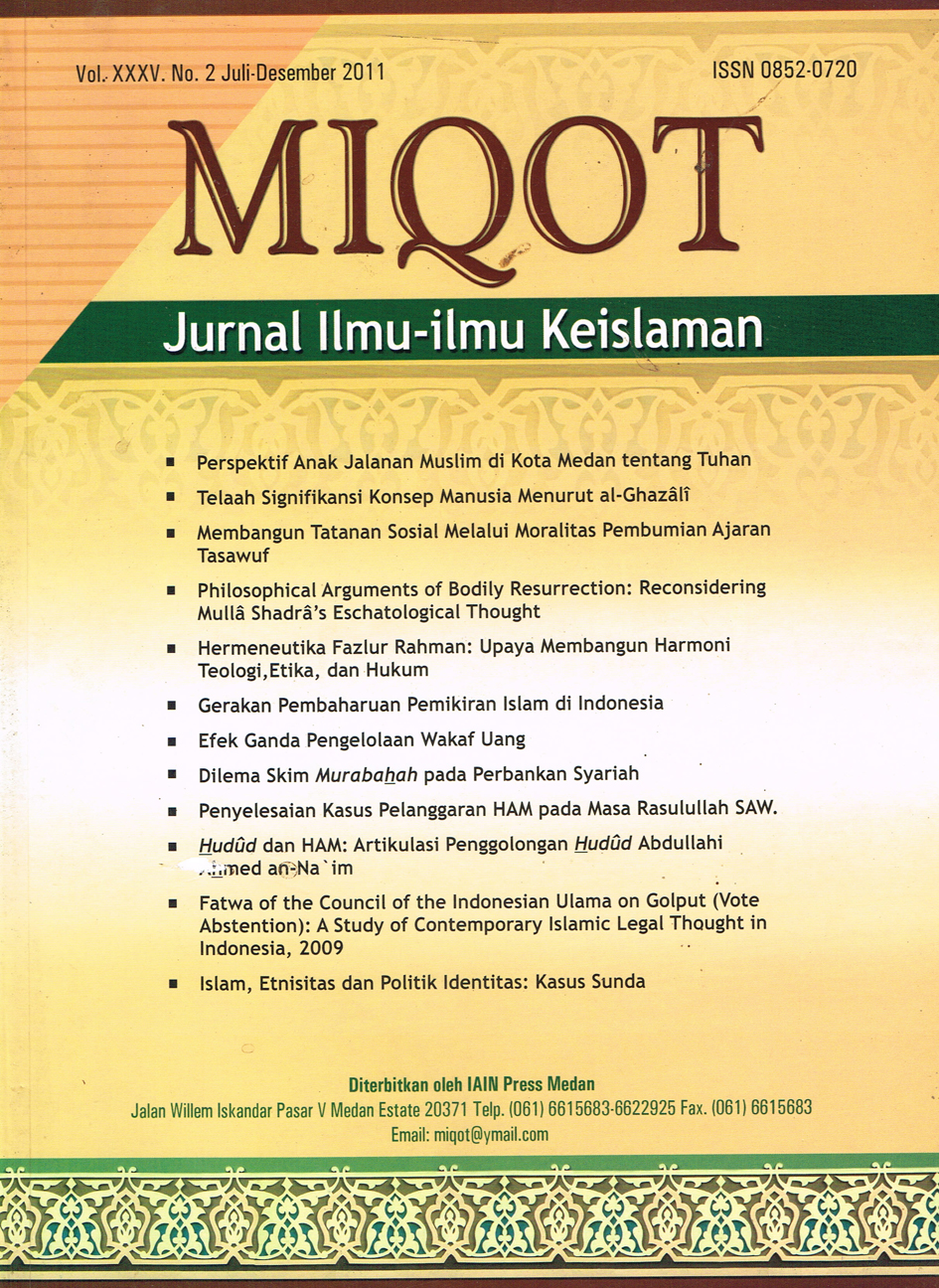
Downloads
Published
2011-12-02
Issue
Section
Articles
License
Authors who publish with this journal agree to the following terms:
- Authors are able to enter into separate, additional contractual arrangements for the non-exclusive distribution of the journal's published version of the work (e.g., post it to an institutional repository or publish it in a book), with an acknowledgement of its initial publication in this journal.
- Authors are permitted and encouraged to post their work online (e.g., in institutional repositories or on their website) prior to and during the submission process, as it can lead to productive exchanges, as well as earlier and greater citation of published work (See The Effect of Open Access).
MIQOT journal provides immediate open access to its content on the principle that making research freely available to the public supports a greater global exchange of knowledge. MIQOT journal Open Access articles are distributed under this CC BY SA.