EFEK GANDA PENGELOLAAN WAKAF UANG
DOI:
https://doi.org/10.30821/miqot.v35i2.146Abstract
Abstrak: Selama ini pemanfaatan wakaf cenderung tidak produktif dan meng- abaikan kemungkinan potensi untuk kesejahteraan umum. Tulisan ini mendiskusikan perubahan dan implikasi yang timbul dengan dikeluarkannya Undang-undang Nomor 41 tahun 2004 tentang Wakaf. Penulis mengemukakan bahwa wakaf uang dapat ber- peran dalam menunjang proses pembangunan secara menyeluruh, baik pembangunan sumber daya manusia, maupun ekonomi dan sosial. Investasi wakaf uang dapat disalurkan untuk membantu biaya operasional lembaga-lembaga pendidikan, kese- hatan dan sosial. Di sinilah wakaf uang berperan sebagai salah satu sumber pendanaan alternatif untuk peningkatan kesejahteraan umat. Menurut penulis, introduksi Undang- Undang ini menjadi momentum pemberdayaan wakaf secara produktif.Abstract:TheMultiplier Effects of Currency Endowment Management. The employment of wakaf or endowment thus far tends to be unproductive disregarding the possibility of its potential for the public interest. This writing discusses changes and implication brought by the introduction of Regulation No. 41/2004 concerning Wakaf. The author maintains that currency endowment may function to supporting the process of development throroughly, both in human resources and social economy. Currency endowment investment may be distributed as a mean of assisting operational funding of educational, health and social institutions. It is on this that currency endowment plays the role as an alternative financial resource for the betterment of social prosperity. According to the author, the introduction of this regulation would become an avenue for empowering endowment productively.Kata Kunci: wakaf uang, ekonomi umat, UU No. 41/2004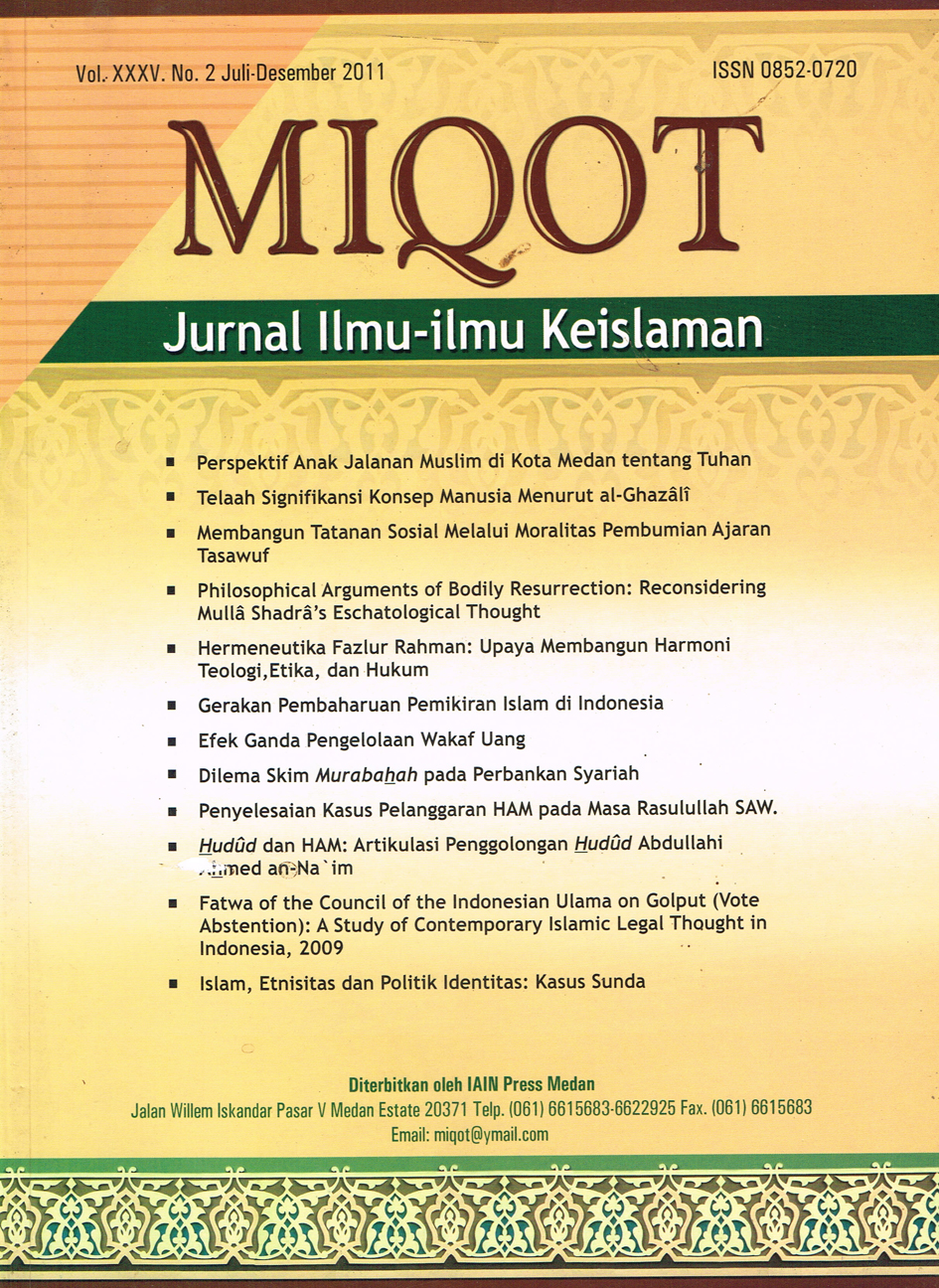
Downloads
Published
2012-12-03
Issue
Section
Articles
License
Authors who publish with this journal agree to the following terms:
- Authors are able to enter into separate, additional contractual arrangements for the non-exclusive distribution of the journal's published version of the work (e.g., post it to an institutional repository or publish it in a book), with an acknowledgement of its initial publication in this journal.
- Authors are permitted and encouraged to post their work online (e.g., in institutional repositories or on their website) prior to and during the submission process, as it can lead to productive exchanges, as well as earlier and greater citation of published work (See The Effect of Open Access).
MIQOT journal provides immediate open access to its content on the principle that making research freely available to the public supports a greater global exchange of knowledge. MIQOT journal Open Access articles are distributed under this CC BY SA.