HERMENEUTIKA FAZLUR RAHMAN: Upaya Membangun Harmoni Teologi, Etika, dan Hukum
DOI:
https://doi.org/10.30821/miqot.v35i2.144Abstract
Abstrak: Tulisan ini mencoba mendiskusikan teori hermeneutika yang ditawarkan oleh Fazlur Rahman mencakup kritik Rahman terhadap teori sebelumnya, baik tradisional maupun kontemporer. Penulis menemukan bahwa Rahman menekankan pentingnya memahami al-Qur’an sebagai keseluruhan dan menjadi satu kesatuan yang utuh. Rahman juga membedakan antara hukum umum (prinsip) dan hukum temporal, dan menekankan pentingnya mempertimbangkan konteks untuk memahami al-Qur’an secara tepat. Penulis berargumen bahwa tujuan akhir teori Rahman adalah untuk membangun harmonisasi tiga aspek ajaran Islam dalam ranah hukum, etika dan hukum yang harus saling mendukung antara satu sama lain, yang didasarkan pada tiga prinsip dasar tatanan hubungan manusia yakni egalitarianisme, keadilan dan konsultasi mutual.Abstract:Fazlur Rahman’s Hermeneutics: An effort to Build Harmony Between Theology, Ethics and Law.This paper attempts to discuss the hermeneutical theory proposed by Fazlur Rahman. It includes therefore the discussion of Rahman’s critique on the existing theories both traditional and contemporary ones. The author finds that Rahman emphasizes the importance of understanding al-Qur’anintegrally as a single whole. He also distinguishes between general laws and temporary laws as well as stresses the importance of considering context to understanding al-Qur’an correctly. The author argues that the ultimate purpose of the theory is to build a harmony among three aspects of Islamic teaching: law, ethics, and theology, each of which has to support one another. In addition, there are three principles on which laws on human relation have to be built, namely egalitarianism, justice, and mutual consultation.Kata Kunci: Al-Qur’an, hermeneutika, Fazlur Rahman, penafsiran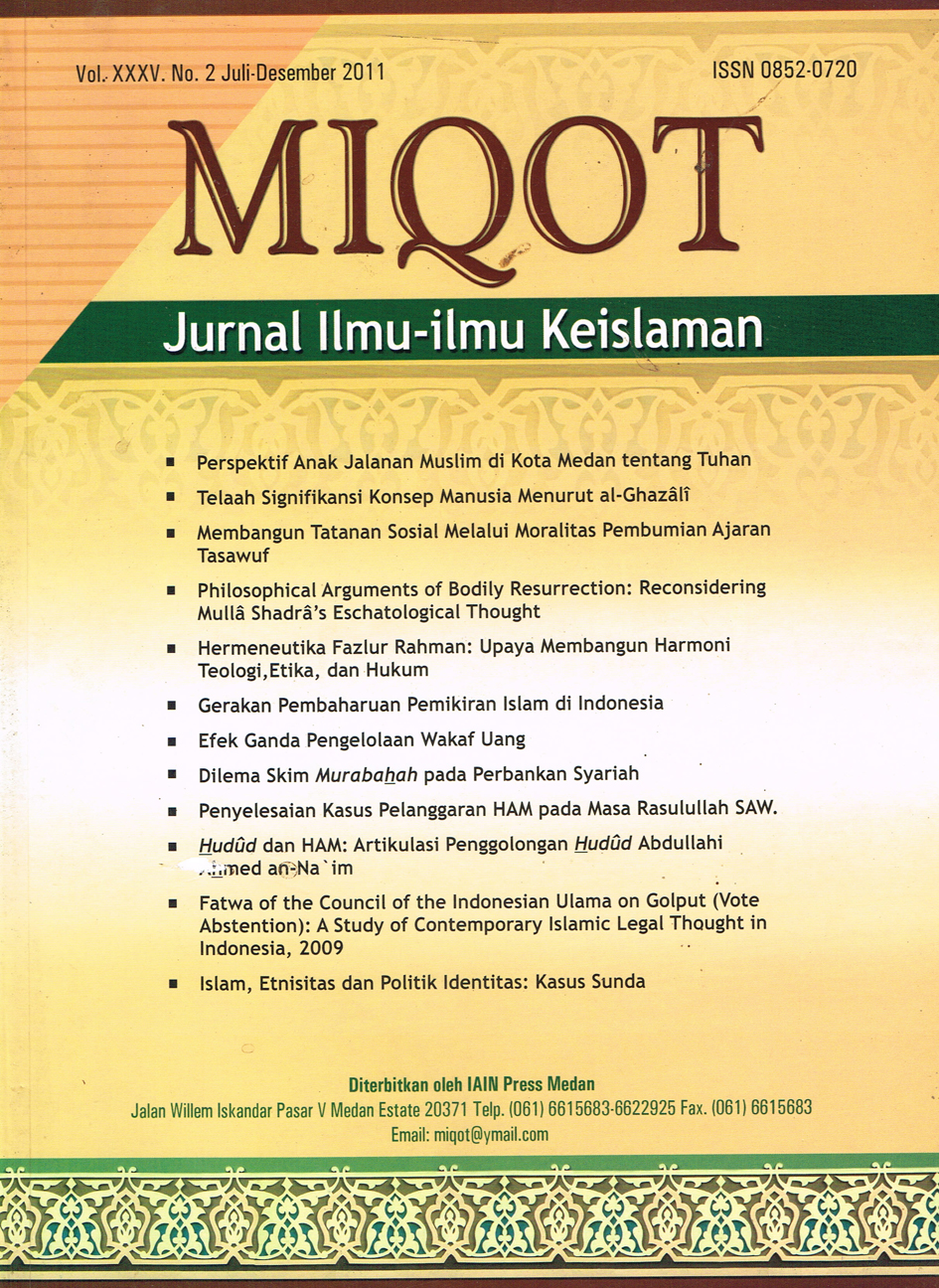
Downloads
Published
2011-12-03
Issue
Section
Articles
License
Authors who publish with this journal agree to the following terms:
- Authors are able to enter into separate, additional contractual arrangements for the non-exclusive distribution of the journal's published version of the work (e.g., post it to an institutional repository or publish it in a book), with an acknowledgement of its initial publication in this journal.
- Authors are permitted and encouraged to post their work online (e.g., in institutional repositories or on their website) prior to and during the submission process, as it can lead to productive exchanges, as well as earlier and greater citation of published work (See The Effect of Open Access).
MIQOT journal provides immediate open access to its content on the principle that making research freely available to the public supports a greater global exchange of knowledge. MIQOT journal Open Access articles are distributed under this CC BY SA.