PHILOSOPHICAL ARGUMENTS FOR BODILY RESURRECTION: Reconsidering Mullâ Shadrâ’s Eschatological Thought
DOI:
https://doi.org/10.30821/miqot.v35i2.143Abstract
Abstrak: Argumen Filosofis Kebangkitan Jasmani: Mengkaji Ulang Pemikiran Eskatologi Mullâ Shadrâ. Selain meneliti tentang makna kematian, hakikat ruh, bukti adanya kehidupan setelah mati, eskatologi juga mengkaji tentang kebangkitan ruh dan jasmani. Berkenaan dengan ruh, hampir seluruh filosof Muslim menyepakati tentang adanya kebangkitan ruh. Sementara terkait dengan jasmani, sebagian filosof mengatakan akan dibangkitkan dan sebagian yang lain berpendapat tidak mungkin dibangkitkan. Berbeda dengan para filosof essensialis sebelumnya, Mullâ Shadrâ yang menganut aliran eksistensialis menyatakan bahwa sebagaimana ruh, jasmani manusia pun akan ikut dibangkitkan di hari kemudian. Shadrâ berargumen melalui pendekatan filsafat eksistensialis yang bertumpu pada prinsip harakah al- jauhariyah (trans-substantial motion). Melalui pendekatan ini, Shadrâ berhasil mem- buktikan secara filosofis tentang keharusan kebangkitan ruh dan jasmani secara bersamaan di hari kemudian.Abstract: Apart from investigating the meaning of death, reality of soul, proof of life after death, eschatology also studies the sole bodily resurrection. With regard to soul, almost all Muslim philosophers agree on soul resurrection, but they differ however, as far as the body is concerned. Different to the previous essensialists philosophers, Mullâ Shadrâ who adhered to existentialist school argued that as the case of soul, man’s body itsel would be similarly resurrected in the hereafter. Shadrâ supported his argument by existensialist philosophy approach leaned on the principle of trans-substantial motion. Through this approach, Shadrâ succeeded philosophically in proofing the necessity ofsouland bodily resurrection simultaneously in the hereafter.Key Words: eschatology, soul, body,mabda‘, ma‘ad, resurrection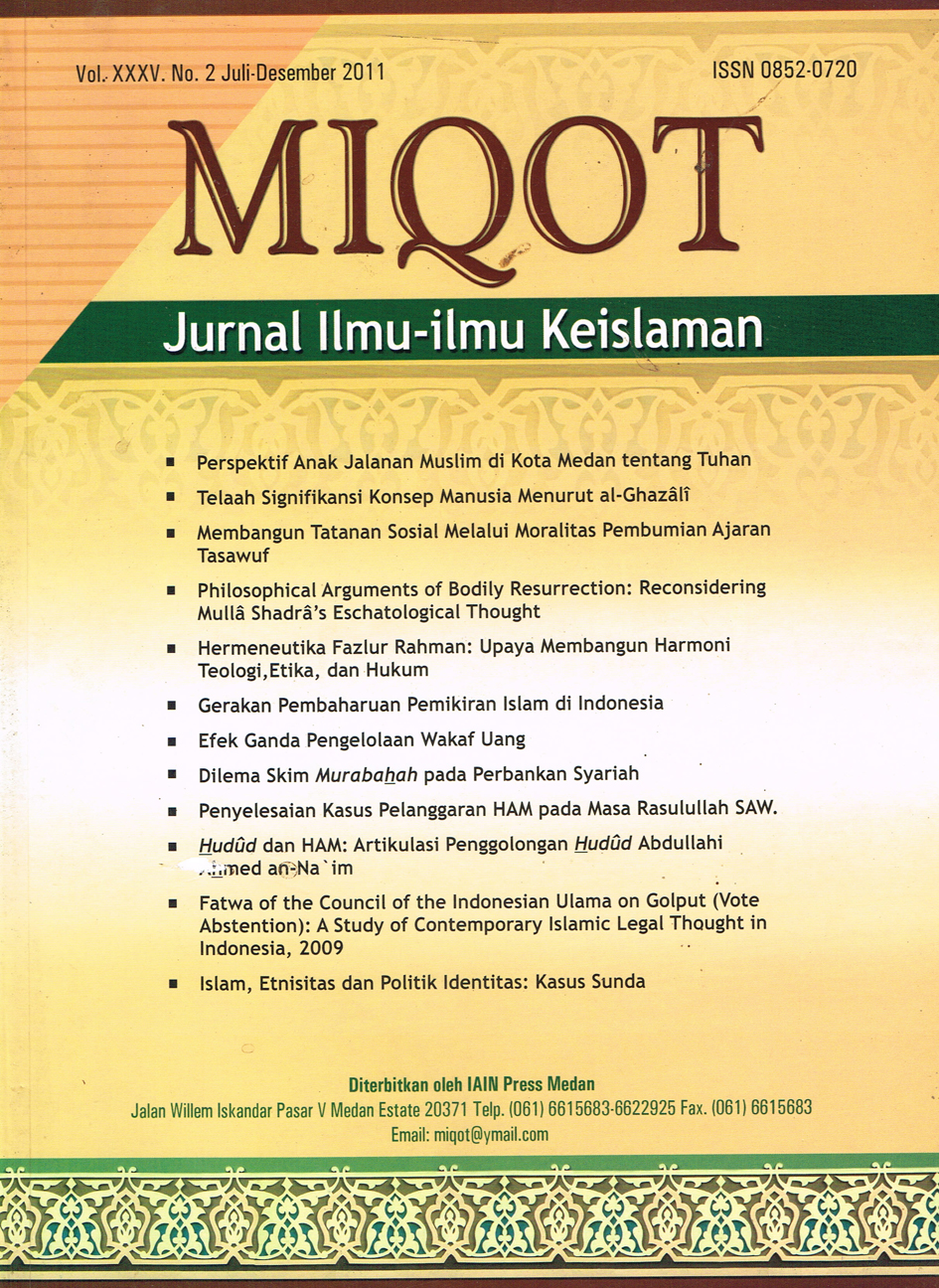
Downloads
Published
2011-06-02
Issue
Section
Articles
License
Authors who publish with this journal agree to the following terms:
- Authors are able to enter into separate, additional contractual arrangements for the non-exclusive distribution of the journal's published version of the work (e.g., post it to an institutional repository or publish it in a book), with an acknowledgement of its initial publication in this journal.
- Authors are permitted and encouraged to post their work online (e.g., in institutional repositories or on their website) prior to and during the submission process, as it can lead to productive exchanges, as well as earlier and greater citation of published work (See The Effect of Open Access).
MIQOT journal provides immediate open access to its content on the principle that making research freely available to the public supports a greater global exchange of knowledge. MIQOT journal Open Access articles are distributed under this CC BY SA.