MUSYRAKAH: ANTARA FIKIH DAN PERBANKAN SYARIAH
DOI:
https://doi.org/10.30821/miqot.v36i1.109Abstract
Abstrak: Musyârakah merupakan salah satu model profit and lost-sharing (PLS) yang kehadirannya dalam bank syari‘ah paralel dengan Islam. Musyârakah dalam praktik perbankan syariah tidak dikonstruk melalui fikih an sich, tetapi telah diadaptasikan dengan situasi dan kondisi riil yang didasarkan pada fikih lokal kekinian, KHI atau fatwa MUI. Dalam fikih klasik, ulama sepakat bahwa jaminan, misalnya, tidak perlu mewujud dalam kontrak musyârakah, karena mitra adalah orang yang dipercaya, dan atas dasar “kepercayaan” ini, maka mitra yang satu tidak dapat menuntut jaminan dari mitra yang lain. Namun fikih lokal memberikan kelonggaran kepada bank syariah mensyaratkan mitranya untuk memberikan jaminan guna mereduksi risiko dalam pembiayaan musyârakah.Abstract: Musyârakah: Between fiqh and Syariah banking. Musyârakah is one of the profit and lost-sharing (PLS) models which is parallel with Islamic bank concept. At the practical level of syariah banking, musyârakah is not purely legal construction but it is a social adaptation to the real circumstances which are based on contemporary local fiqh (Islamic law). Classical fiqh does not require the guarantee to be embodied in a musyârakah contract, because the partner is a trustworthy person. Moreover, on the basis of trust, one partner cannot require a guarantee from the other party. Otherwise, local fiqh gives concessions to Islamic bank, i.e., it requires partners to provide assurance in order to reduce risk in the musyârakah financing.Kata Kunci: musyârakah, bagi hasil, fikih muamalah, bank syari‘ah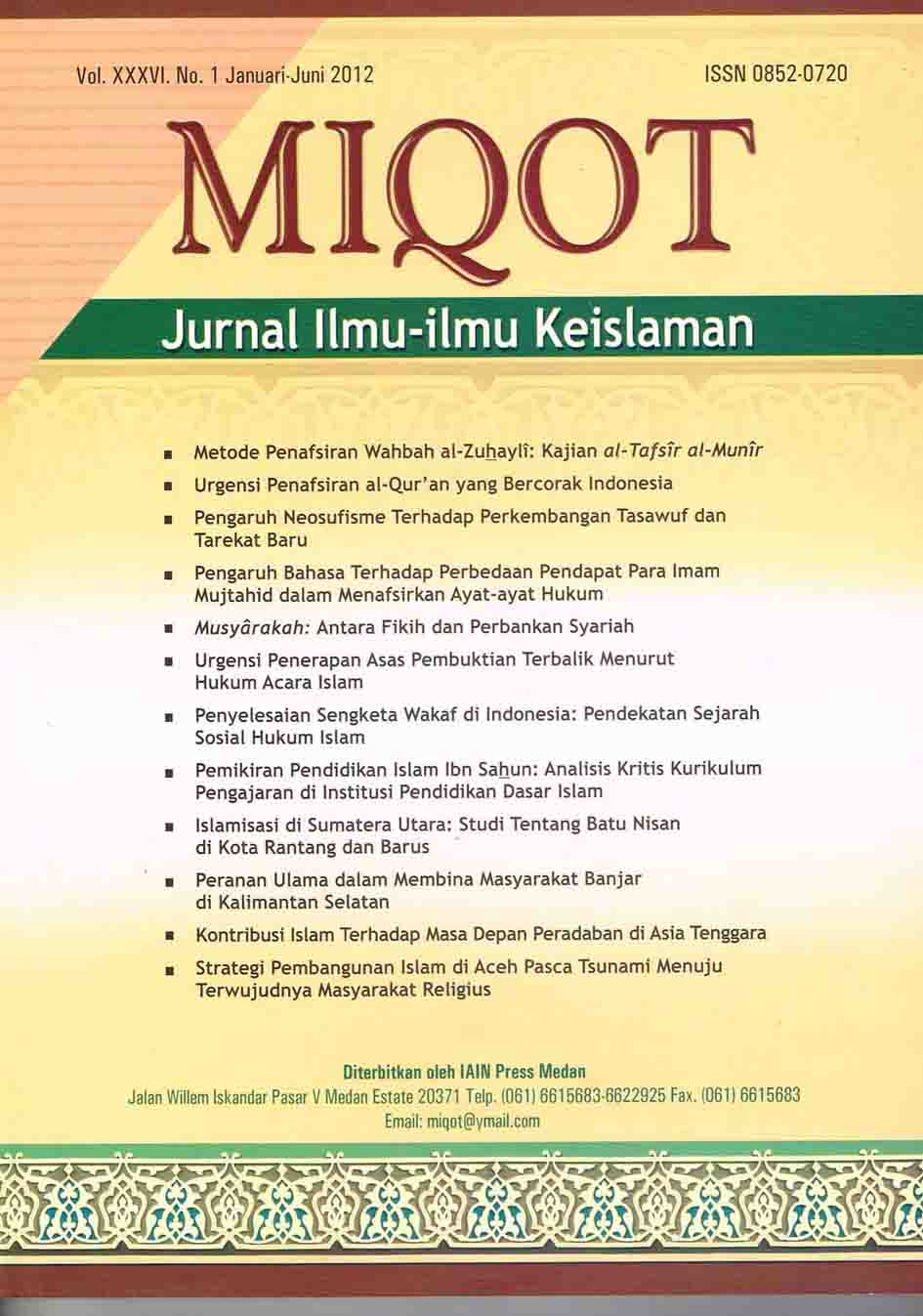
Downloads
Published
2016-02-10
Issue
Section
Articles
License
Authors who publish with this journal agree to the following terms:
- Authors are able to enter into separate, additional contractual arrangements for the non-exclusive distribution of the journal's published version of the work (e.g., post it to an institutional repository or publish it in a book), with an acknowledgement of its initial publication in this journal.
- Authors are permitted and encouraged to post their work online (e.g., in institutional repositories or on their website) prior to and during the submission process, as it can lead to productive exchanges, as well as earlier and greater citation of published work (See The Effect of Open Access).
MIQOT journal provides immediate open access to its content on the principle that making research freely available to the public supports a greater global exchange of knowledge. MIQOT journal Open Access articles are distributed under this CC BY SA.